The 12 principles of animation
1.Squash and stretch
The squash and stretch principle is about stretching and squashing the character or object that is being animated to give the feeling of flexibility and life. the absence of this principle could lead to an animation being to stiff or not attractive.
2. Anticipation
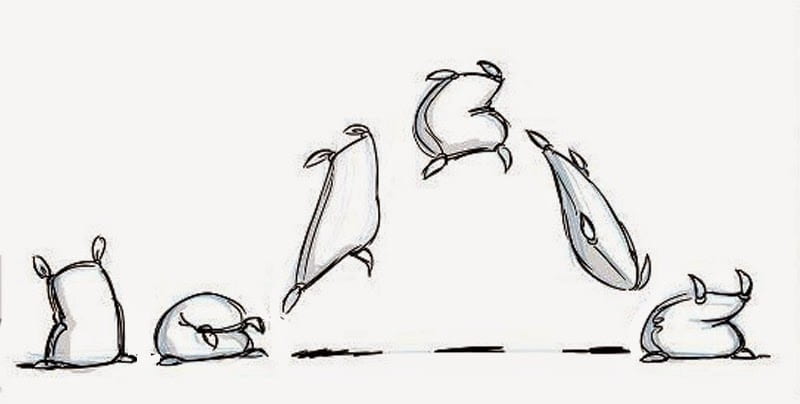
The use of this principle let the viewer predict what is the character featured in the animation what is going to do next, giving more emphasis to the movement, add realism and do not let the viewer loss anything from the action.
3. Staging
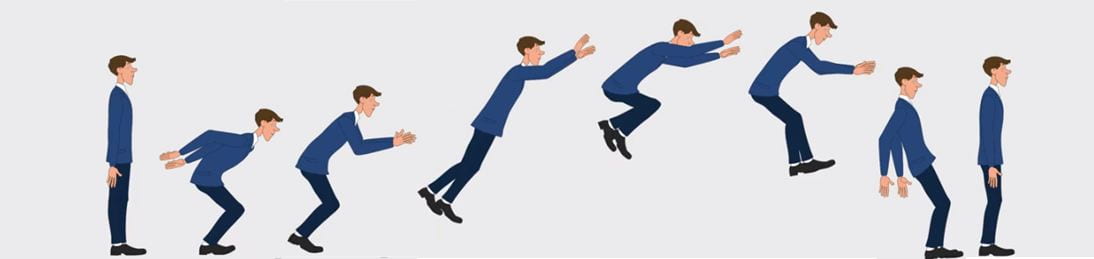
Staging is one of the most important principles, because it defines the composition and position of the scene and characters, without the right staging the scene become unclear and will fail to archive the immersion from the animation.

4. Timing and Spacing

5. Ease In and Ease Out

As any object moves or comes to a stop, there needs to be a time for acceleration and deceleration. Without ease in and ease out (or slow in and slow out), movements become very unnatural and robotic.
As a car moves away from a stop, it doesn’t just reach full speed in an instant. It must first gain speed. As it comes to a stop, it doesn’t go from sixty to zero in the blink of an eye. Instead, it slows down until it reaches a complete stop.
The same must be accomplished in animation and the easiest way to accomplish ease in and ease out is to utilize the principle of spacing. As a character stands up from a sitting position, the spacing of each pose will be closer together at the start so that they can ease into the movement. As they stand up, they will ease out of the movement by spacing the poses further apart at the end of the action. Without this acceleration and deceleration of actions, everything would be very abrupt and jerky.
6. Follow Through and Overlapping Action

Follow through is the idea that separate parts of the body will continue moving after the character has come to a stop. As a character comes to a stop from a walk, the arms may continue forward before settling in a down position. This could also be the case with articles of clothing.
Overlapping action (also called “drag” or “lead and follow”) is very similar in that it means different parts of the body will move at different times. An example of overlapping action is when a character raises their arm up to wave: The shoulder will move first, then the arm, and then the elbow, before the hand lags behind a few frames. You can also see this when a blade of grass waves in the wind. The base moves first and then the rest of the grass follows behind at different rates, giving it that waving motion.
Additionally, characters who are remaining still need to display some sort of movement (blinking eyes, breathing, etc.) to prevent the animation from becoming “dead.” This is called “moving hold.”
7. Arcs

Everything in real life typically moves in some type of arcing motion. Since it’s unnatural for people to move in straight lines, you should adhere to this principle of animation to ensure you get smooth, realistic movements. The quicker something moves, the flatter the arc and the broader the turn. The only time something would move in a perfectly straight line is a robot.
If a character is turning his head, he will dip his head down during the turn to create an arcing motion. You also want to ensure that more subtle things move in arcs. For example, when a character walks, even the tips of their toes should move in a rounded, arcing motion.
8. Exaggeration

Exaggeration is used to push movements further, adding more appeal to an action, and should always be implemented to some degree.
Exaggeration can be used to create extremely cartoony movements including physical alterations or supernatural elements. Or, exaggeration can be incorporated with a little more restraint for more realistic actions. But, even then you can still use exaggeration to make a more readable or fun movement while still staying true to reality.
So, if a character is preparing to jump off a diving board, you can push them down just a little bit further before they leap off. Alternatively, you can use exaggeration in the timing to enhance different movements or help sell the weight of a character or object.
9. Solid Drawing

In 2D animation, solid drawing is about creating an accurate drawing in terms of volume and weight, balance, shadow, and the anatomy in a pose. With 3D animation, animators need to think about how to pose out your 3D character rig to ensure there is correct balance and weight, as well as a clear silhouette.
Avoid “twinning,” which is creating a mirrored pose across to the other side (both arms on hips or both hands in pockets) because this creates a rather boring and unappealing pose.
10. Appeal
This principle can really come down to adding more appeal (charisma) in many different areas of your animation, such as in posing. The most obvious example, however, is appeal in the character design because you want to have a character that the audience can connect with or relate to, whereas a complicated or confusing character design can lack appeal.
You can find areas on the character to push and exaggerate in order to create a more unique design that will stick out in your audience’s memory. One example is to simply exaggerate the jawline or push the youthfulness in the eyes. Either of these can help create more appeal.
Keep in mind that appeal is also required for villains.
11. Straight Ahead Action and Pose to Pose

Straight ahead action is a very spontaneous and linear approach to animating and is animated from start to finish, frame by frame. With this, you’ll create each pose of the animation one after the other. So, if your character is landing on the ground after jumping in the air, you would create the poses where he is standing, then the poses where he is beginning to kneel down, and then completely crouched. In other words, you’re really working through the animation as you’re going to make quick action fluid and dynamic.
With pose to pose, the animation is much more methodical, with just the most important poses required to properly tell the story. You would animate the character landing on the ground after jumping in the air by using fewer poses (standing and crouched). This allows for more simple work and ensures the proportions and timing are correct before you add more intervals later, and is great for slow, dramatic, or emotional scenes.
12. Secondary Action

Secondary action refers to the actions that support or emphasize the main action to breathe more life into the animation and create a more convincing performance. It’s important to remember that the secondary action should typically be something subtle that doesn’t detract from the main action happening (perhaps even thought of as a subconscious action). For this reason, dramatic movements take priority over things like facial expressions.
Let’s say a character is talking to another character in a waiting room. The two of them talking would be the main action, but if one of them begins tapping their foot nervously, that would be the secondary action. Other examples would be a character whistling, leaning on a wall, or crossing their arms while a primary action is taking place.
End of task 1

